Cornflour vs Cornstarch: Are They the Same?
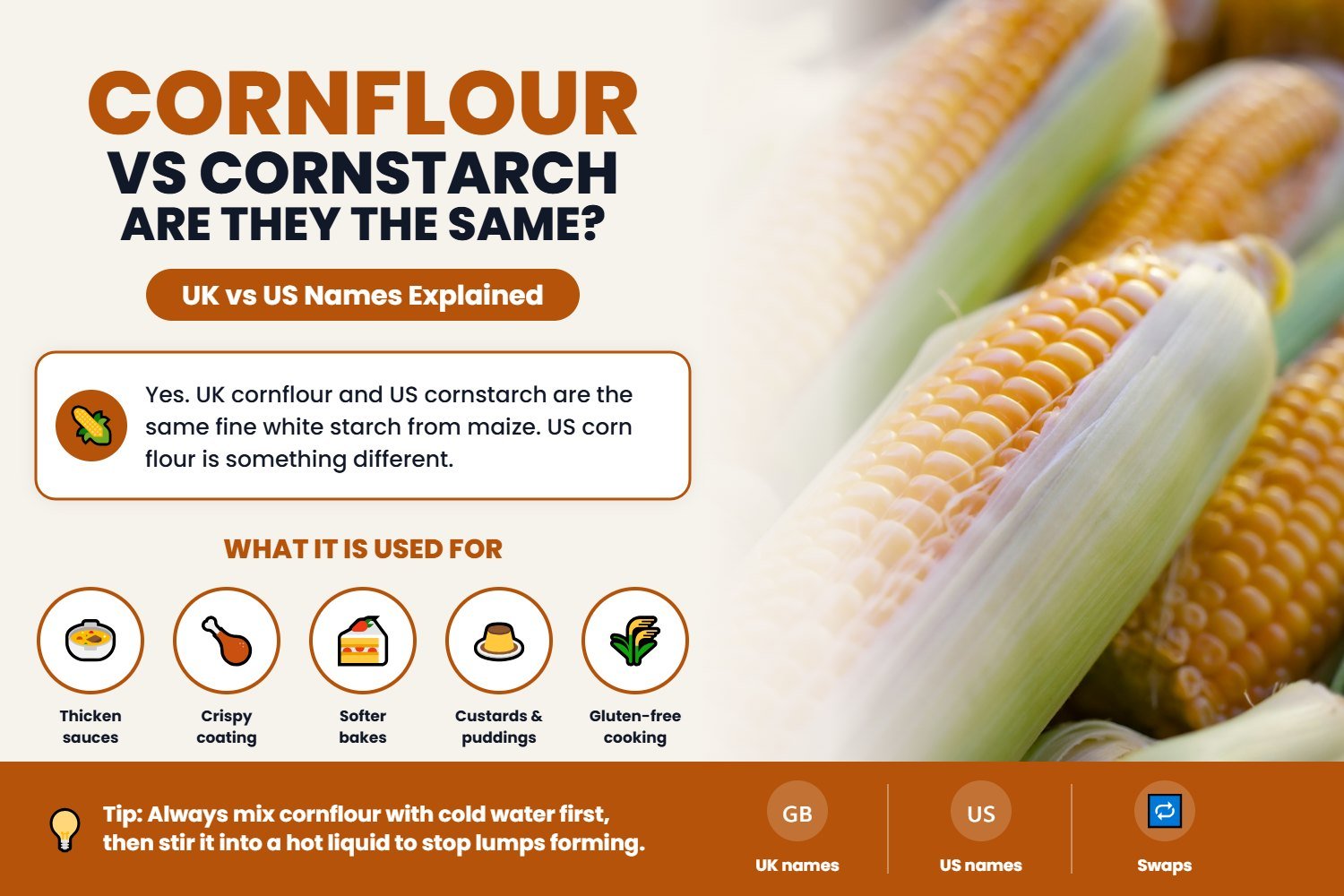
Yes, cornflour and cornstarch are the same thing. Cornflour is the British name and cornstarch is the American name for the same fine, white powder made from the starchy centre of maize kernels. The confusion comes from the fact that in the US, “corn flour” means something different: a yellow flour made by grinding whole corn kernels.
This guide explains the difference between the names, what each product is used for, how to swap them in recipes and which other corn products are easy to mix up.
The Short Answer
- UK cornflour = US cornstarch: the same pure white starch from maize.
- US corn flour is different: it is yellow, finely ground whole corn, more like the UK’s maize flour.
- Main use: thickening sauces, gravies, custards and soups, and making coatings crispy.
- Thickening power: about twice as strong as plain wheat flour.
- Gluten: naturally gluten-free, but always check the label for cross-contamination.
What Is Cornflour?
Cornflour is made from the endosperm, the starchy white part inside each maize kernel. The outer skin and the germ are removed, and the starch is dried into a fine, silky powder. Because it is almost pure starch, it has very little flavour and turns clear and glossy when it is cooked in a liquid.
In the UK, Ireland and many Commonwealth countries, this product is sold as cornflour. Popular brands sell it in small boxes or tubs in the baking aisle.
What Is Cornstarch?
Cornstarch is simply the American name for the same product. If a US recipe tells you to use cornstarch, you can use UK cornflour in exactly the same amount.
What Is US Corn Flour?
In the US, corn flour is made by grinding the whole dried maize kernel into a fine yellow powder. It contains the protein, fibre and fat from the whole grain, so it has a sweet corn flavour and behaves like a flour rather than a thickener. It is used in cornbread, batters and some breads. In the UK, the closest product is usually sold as maize flour or fine cornmeal.
Cornflour vs Corn Flour vs Cornmeal
| Product | What it is | Colour and texture | Main uses |
|---|---|---|---|
| UK cornflour / US cornstarch | Pure starch from the centre of the maize kernel | White, very fine and silky | Thickening sauces, custards, crispy coatings |
| US corn flour / UK maize flour | Whole maize kernel, finely ground | Yellow, fine | Cornbread, batters, tortillas |
| Cornmeal | Whole maize kernel, coarsely ground | Yellow, gritty | Cornbread, coating fish, muffins |
| Polenta | Coarse ground maize, or the cooked dish | Yellow, coarse | Italian polenta, baking |
| Masa harina | Maize treated with lime, then ground | Pale yellow, fine | Tortillas, tamales |
One more thing to watch for: in Australia and New Zealand, some products labelled “wheaten cornflour” are made from wheat, not maize. These contain gluten, so they are not suitable for coeliacs.
What Is Cornflour Used For?
- Thickening sauces and gravies: mix it with cold water to make a slurry, then stir it into a simmering liquid. See our full guide to thickening sauce without flour.
- Custards and puddings: it helps custard set smoothly without curdling.
- Crispy coatings: a light dusting of cornflour gives fried chicken, tofu and vegetables a crisp, golden crust.
- Softer bakes: a little cornflour in shortbread, sponges and cookies makes them more tender.
- Velveting meat: in Chinese cooking, meat is coated in cornflour and egg white before stir-frying to keep it soft and juicy.
How to Substitute Them
Because UK cornflour and US cornstarch are the same product, you can swap them one for one. Other swaps need adjusting:
- Plain flour instead of cornflour: use about 2 tablespoons of plain flour for every 1 tablespoon of cornflour, and cook it for a few minutes longer to remove the raw taste.
- Arrowroot or potato starch instead of cornflour: use roughly the same amount. They give a similar glossy finish.
- Cornflour instead of US corn flour: do not do this. Cornflour is pure starch and will not work in cornbread or batters that need a whole-grain flour.
Is Cornflour Gluten-Free?
Maize does not contain gluten, so pure cornflour is naturally gluten-free. However, it may be processed in factories that also handle wheat. If you are cooking for someone with coeliac disease, choose a product labelled gluten-free. Coeliac UK has more guidance on reading food labels.
Tips for Cooking With Cornflour
- Always mix cornflour with a cold liquid before adding it to anything hot, or it will form lumps.
- Add the slurry to a simmering liquid and stir until it turns clear and glossy, usually within 1 to 2 minutes.
- Do not boil it hard for a long time, as this can make the sauce go thin again.
- Sauces thickened with cornflour can turn watery when frozen and thawed, so they are best made fresh.
Frequently Asked Questions
Is cornflour the same as cornstarch?
Yes. Cornflour is the UK name and cornstarch is the US name for the same fine white starch made from maize.
Can I use cornflour instead of cornstarch in an American recipe?
Yes. Use exactly the same amount of UK cornflour.
What is the difference between cornflour and corn flour?
In the UK, cornflour is a white starch used for thickening. In the US, corn flour is a yellow flour made from whole ground maize, which is used for baking.
Can I use plain flour instead of cornflour?
Yes, but you need about twice as much, and the sauce will be less glossy and slightly cloudy.
Is cornflour healthy?
Cornflour is mostly carbohydrate with very little fibre or protein. It is used in small amounts, so it adds few calories to a typical sauce.
Final Thoughts
Cornflour and cornstarch are the same ingredient with two names, one British and one American. The product to be careful with is US corn flour, which is a yellow whole-grain flour and behaves very differently. Use cornflour for thickening and crispy coatings, and choose maize flour or cornmeal when a recipe needs the flavour of corn. For more kitchen basics, read our guides to making a roux and binders in cooking, or browse all our food and cooking guides.