
What Is a Roux in Cooking? Types, Ratios and How to Make One
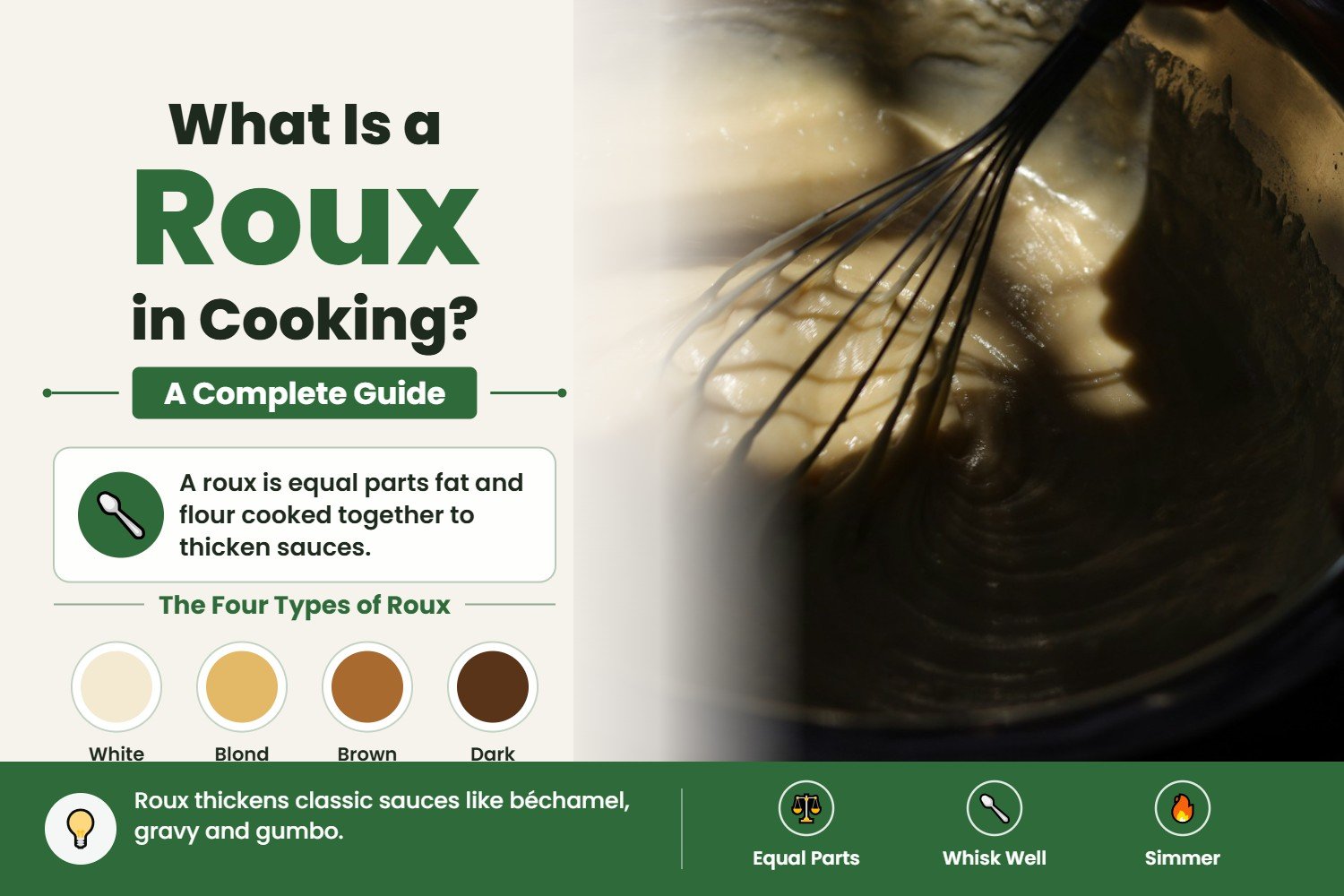
A roux is a mixture of fat and flour cooked together and used to thicken sauces, soups and stews. It is one of the most important building blocks in cooking: it gives a cheese sauce its smooth, creamy texture, turns stock into gravy and forms the dark, nutty base of a Louisiana gumbo.
This guide explains what a roux is, the different types, the right ratios, how to make one without lumps and how it compares with other thickeners. If you are also curious about ingredients that hold food together rather than thicken it, read our guide to what a binder is in cooking.
The Short Answer
- What it is: equal parts fat and flour by weight, cooked together into a paste.
- What it does: thickens liquids such as milk and stock into smooth sauces, soups and gravies.
- Four main types: white, blond, brown and dark, depending on how long it cooks.
- Key rule: the darker the roux, the more flavour it has but the less it thickens.
What Is a Roux?
A roux (pronounced “roo”) is made by melting fat, usually butter, and stirring in the same weight of plain flour. The mixture is cooked over a gentle heat while you stir. Cooking the flour in fat does two things: it removes the raw, floury taste, and it coats each grain of flour in fat so that it can be mixed into liquid without forming lumps.
When liquid is whisked into a roux and brought to a simmer, the starch in the flour swells and thickens it. This is why a roux is the base of three of the five classic French “mother sauces”: béchamel (made with milk), velouté (made with light stock) and espagnole (made with brown stock).
The Four Types of Roux
The colour of a roux depends on how long it cooks. Each stage has its own flavour and its own best uses.
White Roux
Cooked for just 2 to 3 minutes, until the raw flour smell disappears but before it takes on any colour. White roux has the strongest thickening power and a neutral taste. Use it for béchamel, cheese sauce, macaroni cheese and creamy soups.
Blond Roux
Cooked for around 5 to 6 minutes, until it turns a pale golden colour and smells slightly nutty. It is used for velouté sauces, chicken or fish gravies and many cream-based soups.
Brown Roux
Cooked for roughly 15 to 20 minutes over a low heat, until it is the colour of peanut butter. Brown roux adds a deeper, toasted flavour and is used for rich gravies, beef stews and espagnole sauce.
Dark Roux
Cooked slowly for 30 minutes or more, stirring constantly, until it reaches a deep chocolate brown. Dark roux is famous as the base of Cajun and Creole dishes such as gumbo. It has a strong, smoky flavour but very little thickening power, so it is used mainly for taste and colour.
Roux Types at a Glance
| Type | Cooking time | Colour | Thickening power | Best for |
|---|---|---|---|---|
| White | 2 to 3 minutes | Pale cream | Strongest | Béchamel, cheese sauce, creamy soups |
| Blond | 5 to 6 minutes | Light golden | Strong | Velouté, poultry gravy, cream soups |
| Brown | 15 to 20 minutes | Peanut butter | Medium | Beef gravy, stews, espagnole |
| Dark | 30 minutes or more | Chocolate brown | Weak | Gumbo and Cajun dishes |
How Much Roux Do You Need?
The classic ratio is equal parts fat and flour by weight. As a simple kitchen guide, for every 250 ml (about 1 cup) of liquid:
- Thin sauce or soup: 1 tablespoon butter and 1 tablespoon flour.
- Medium sauce (such as a cheese sauce): 2 tablespoons butter and 2 tablespoons flour.
- Thick sauce (for binding fillings or croquettes): 3 tablespoons butter and 3 tablespoons flour.
Remember that darker roux thickens less, so you will need more of it to reach the same thickness.
How to Make a Roux Step by Step
- Melt the fat. Melt the butter in a heavy-based pan over a medium-low heat.
- Add the flour. Stir in the same weight of plain flour until you have a smooth paste.
- Cook and stir. Keep stirring with a wooden spoon or whisk until the roux reaches the colour you want. Lower the heat for darker roux so it does not burn.
- Add the liquid gradually. Pour in the liquid a little at a time, whisking constantly to keep the sauce smooth.
- Simmer. Bring the sauce to a gentle simmer for a few minutes. A roux only reaches its full thickness once it simmers.
Tips for a Lump-Free Roux
- Combine a hot roux with cold or room-temperature liquid, or a cooled roux with hot liquid. Mixing hot with hot is the most common cause of lumps.
- Add liquid gradually at first, whisking well after each addition.
- If lumps do form, whisk vigorously or pass the sauce through a sieve.
- Never leave a dark roux unattended. If you see black specks or smell burning, start again, as burnt roux tastes bitter.
Roux vs Other Thickeners
| Thickener | How it works | Best for |
|---|---|---|
| Roux | Flour cooked in fat, then whisked into liquid | Rich, smooth sauces, gravies and soups |
| Cornflour slurry | Cornflour mixed with cold water, stirred in at the end | Quick, glossy sauces and stir-fries |
| Beurre manié | Raw butter and flour kneaded together, added at the end | Last-minute thickening of stews |
| Reduction | Simmering liquid to evaporate water | Pan sauces with concentrated flavour |
Can You Make a Roux Without Butter or Wheat?
Yes. Oil, lard or bacon fat all work in place of butter, and vegetable oil is the traditional choice for dark gumbo roux because it burns less easily. For a gluten-free roux, rice flour or a plain gluten-free flour blend can be used instead of wheat flour, although the texture may be slightly different.
Frequently Asked Questions
What is a roux made of?
A roux is made of equal parts fat and flour by weight. Butter and plain flour are the most common choice.
What is the ratio for a roux?
The standard ratio is 1:1 fat to flour by weight. For a medium sauce, use about 2 tablespoons each of butter and flour for every 250 ml of liquid.
Why is my roux sauce lumpy?
Lumps usually form when liquid is added too quickly or when hot liquid is mixed into a hot roux. Add the liquid gradually and whisk constantly.
Can you make roux ahead of time?
Yes. Cooled roux can be kept covered in the fridge for about a week or frozen in portions, then added straight to hot liquid when you need it.
What is the difference between a roux and a slurry?
A roux is flour cooked in fat before liquid is added, giving a rich flavour. A slurry is cornflour mixed with cold water and stirred in at the end, giving a lighter, glossier finish.
Final Thoughts
A roux is simple to make but transforms everyday cooking, from creamy cheese sauces to deep, rich gravies. Once you know the ratios and the four colours, you can thicken almost any sauce with confidence. For more kitchen basics explained simply, see our guide to binders in cooking or browse all our food and cooking guides.